The VVD calls itself the People’s Party for Freedom and Democracy. It claims to stand for individual rights, personal responsibility, and social progress. Similarly, the CDA is a Christian-democratic party that, in recent years, has become more active in queer rights. Both parties march at Pride, defend free speech, and promote themselves as liberal or centrist forces in Dutch politics. Yet the reality behind the slogans tells a more complicated story.
Although the most recent right-wing cabinet has now fallen just when I was writing this article, it came into existence only through the support of the VVD. And they were far from a passive part of it. Their decisions during and after coalition talks have played a decisive role in bringing far-right ideas closer to the center of power. There are many ways to describe these parties, pragmatic, strategic, centrist, but one thing is becoming harder to ignore: both have helped legitimize exclusionary rhetoric. They may wave the rainbow flag, but when freedom becomes conditional, that symbolism starts to ring hollow.
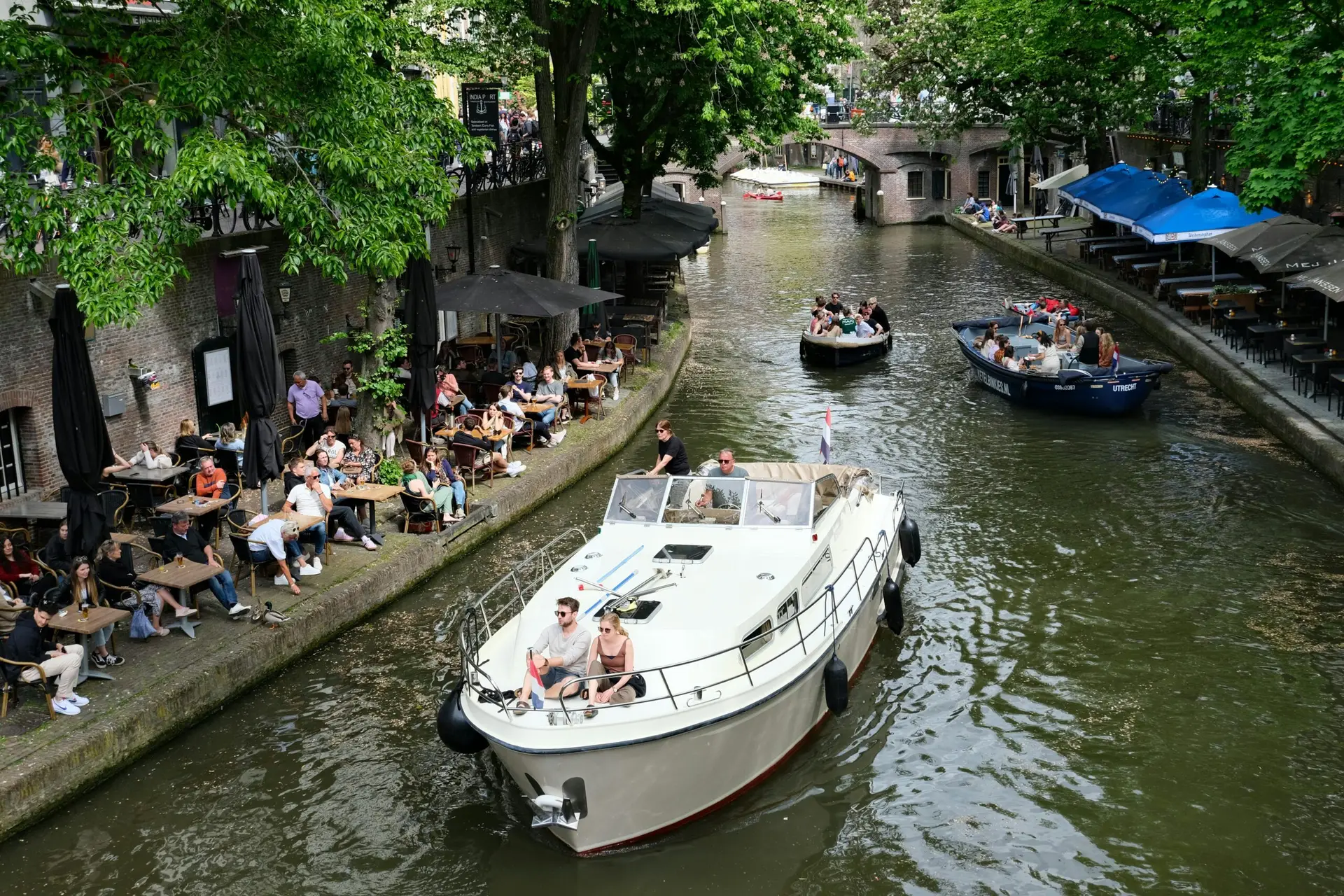
As the Utrecht Canal Pride approaches, it’s time to pay closer attention. And it’s time to reconsider whether sharing a Pride boat with either the VVD or the CDA still reflects the values we march for.
Not every rhyme is a warning, but some should be
Neither the VVD nor the CDA are beyond criticism, but neither are they the obvious villains. Both have supported LGBTQ+ rights in the past: the VVD voted for marriage equality and backed the Regenboog Stembusakkoord, while the CDA, despite voting against marriage equality at the time, has since attempted to reposition itself as an ally. The VVD even supported sending a Dutch delegation to Budapest Pride, despite a ban by the Hungarian government. These are not minor gestures. But symbolic support does not erase political complicity.
No party stands alone. Politics is shaped by alliances, silences, and compromises—and positions matter. Especially the VVD now rhymes with right-wing forces. And at some point, the rhyme carries weight.
The political climate has hardened. Their rhetoric has, too. Their willingness to govern with parties that actively undermine queer rights and other democratic norms says more than their presence at Pride ever could. What follows is not a dismissal of their past achievements, but a closer look at their present: at the language they adopt, the ideas they entertain, and the narratives they help legitimize. Rhetoric matters. So does the company one keeps. And when parties that once helped expand rights begin to echo frameworks that threaten them, it demands attention.
Power shared is power endorsed
The call to question the VVD’s presence at Pride is not new. Last year, Jenny Rozema argued as much in a widely read BNNVARA opinion piece. Her critique applies just as much to the CDA today. The most visible issue is that both parties actively enabled the formation of a cabinet that includes forces explicitly hostile to queer rights, anti-racist advocacy, and democratic accountability. This is not just about who holds office—it is about who gets legitimacy in the process. By enabling this coalition, the VVD gave far-right forces not just a platform, but authority.
Most importantly, neither party is a passive bystander in this arrangement. While the VVD might not always vote the same as their more radical partners, they increasingly endorse similar rhetoric. Power shared is not just power endorsed—it is power created together.
The VVD under Dilan Yeşilgöz has used dramatic language to cast “woke” as a threat to the rule of law. These narratives frame movements for racial justice and gender equality as dangers rather than as calls for liberation. Most recently, the VVD has made very clear that right-wing policies is what they want: “After [the cabinet’s fall], there probably won’t be another right-wing government. I am scared about that”.
The VVD have also participated in homonationalist framings, where the rights of queer people are used as rhetorical tools to justify anti-immigration policies. For instance, when VVD officials suggest that Muslim youth do not share “Dutch values,” they construct immigrant communities, especially Muslims, as inherently oppositional to national identity. This is a form of othering that helps fuel racism and islamophobia under the guise of defending liberal norms.
Meanwhile, the state of queer rights in the Netherlands remains far from ideal, after 14 years of VVD leadership. The CDA has recently voted against a ban on conversion therapy, which are a grave violation of the human rights of queer people. Transgender healthcare still has long waiting lists. Intersex infants continue to face non-consensual surgeries. Queer asylum seekers are routinely disbelieved—85% of the time, their claims are rejected. The VVD and CDA jointly blocked a progressive law for self-determination for trans individuals in 2023. These are not abstract policy debates. They have direct impact on queer people.

The story is complex. But it shouldn’t be.
In isolation, both the VVD and CDA can point to achievements in support of queer rights. But the bigger picture partly undermines those credentials. The VVDs participation in a cabinet that fosters exclusionary rhetoric and weakens protections for marginalized communities cannot be offset by marching once a year at Pride. When parties that claim to defend liberal values begin to normalize reactionary ideologies, they must be held accountable.
This was reason enough for RozeLinks—the queer network of GroenLinks—to step off the Amsterdam Pride boat with the VVD. In Utrecht the boat is specifically from the local departments of the parties, which are all more left-leaning and progressive than their countrywide counterparts. So can we just use countrywide policies and rhetoric to discuss this specific pride boat? I say: Yes, and we should. Firstly, no one knows or can see that these are the local departments. It is not clear from the boat, and at least in my surroundings, no one is aware of that. So even if they might be local, the impact of the boat is clearly based on the nationwide aspects. And second, even though they are local parties, they are still part of their nationwide counterparts. If Frans Timmermans (the leader of the Greenleft-Labour alliance) would suddenly use transphobic rhetoric, I would for sure expect the local departments to take action. Until that explicitly happens, the boat can send off a multitude of wrong and disheartening signals to us on the side.
The question is no longer whether these parties still believe in freedom—but whose freedom they prioritize, and at what cost. If the VVD and CDA want to take part in Pride, they should first reckon with the consequences of their political choices. Until then, it is worth asking: what does it mean to share a boat with parties that help steer the country in a direction fundamentally at odds with what Pride represents? With parties like the VVD that actively advocate for right-wing policies?
Pride must be a space for liberation—not a branding opportunity. And because of that, we need to reconsider what this pride boat means to us, whether that means stepping of it, making a statement against the nationwide counterpart or another solution. For example, a boat from the municipal council would still allow local politicians to show and celebrate their support even against party lines. But the current boat made a choice: They stand there as parties, with party logos, flags and merch. And by that, they made the choice to make it about party politics and branding – and they then need to have the guts to face consequences of their political actions. Whatever we do, one thing is clear: Not doing anything is the strongest signal we can send.
Both images created by Sebastian ter Burg.