We were on our way to my partner’s parents in a small Dutch town, walking hand-in-hand. Suddenly, I heard someone yell behind us. “They’re probably shouting to a friend,” I thought. Or maybe I misheard, and my imagination was playing a trick on me.
But then I heard it again—“Fucking homos”—this time clearly understandable. My body immediately tightened, and a thousand questions rushed through my head. “Did I hear it correctly? Who are they? Is it dangerous? And even if I turned around, what would I say?” As I asked myself all these questions, seconds passed, and we walked on. The situation caught me off guard, as it always does. It caught me off-guard, although I expect it around every corner. There are so many unknowns that once you’ve decided what to do, you’ve already walked on, or they have run away. And what you’re left with is just one thought: “Damn, I wish I had finally said something.”
Caught Off Guard, Again and Again
This story is just one example among many that my friends and I have experienced. There is no street, no city, and no time of day when I’m not hyperaware of my surroundings if I’m walking hand-in-hand with my partner or looking just a bit more queer. Many people tell me to just ignore it and not listen, and sometimes I wish I could. But in those moments, it’s not just you being called out—it’s your love, your whole being, everything that’s tender and warm yet incredibly vulnerable.
The Netherlands is often perceived as a safe haven for queer people, but everyone who lives here as a queer person knows this has its limits. Especially gender non-conforming people face discrimination not only on the street, but also in institutions (1). Experiences like mine aren’t exceptions, and I know that whenever I look or act queer in public, the likelihood is high that someone will comment on it. Contrary to what many people I talk to try to convince me of, this has nothing to do with ethnicity or race. In a background interview I once gave to Nieuwsuur, the reporter kept asking, “But who are these people? What do they have in common?”—even after I explained multiple times that it’s always men. It was clear she was looking for a statement that they were mostly people from different backgrounds. This is just one example of how homonationalism (2) manifests in the Netherlands, framing homophobia as something inherently “foreign” or external to Dutch culture, allowing society to distance itself from responsibility and overlook systemic issues rooted deeply within its own culture. But if there’s any systemic issue here, it’s one of patriarchy—because while it’s certainly not all men, it’s always men.
Fortunately, I’ve never been physically attacked, although people close to me have been. Verbal abuse alone, however, can have a significant impact. It feels like someone has broken into your home, because identity can be exactly that: a home. To me, much of that feeling arises because these situations are disruptive and confusing, leaving you stunned and nearly paralyzed. As my story above shows, you’re left questioning so many things. And before you know it, it’s over, you’ve moved on, and you’re left dealing with the aftermath.
Why a Business Card Makes Me Feel More Confident
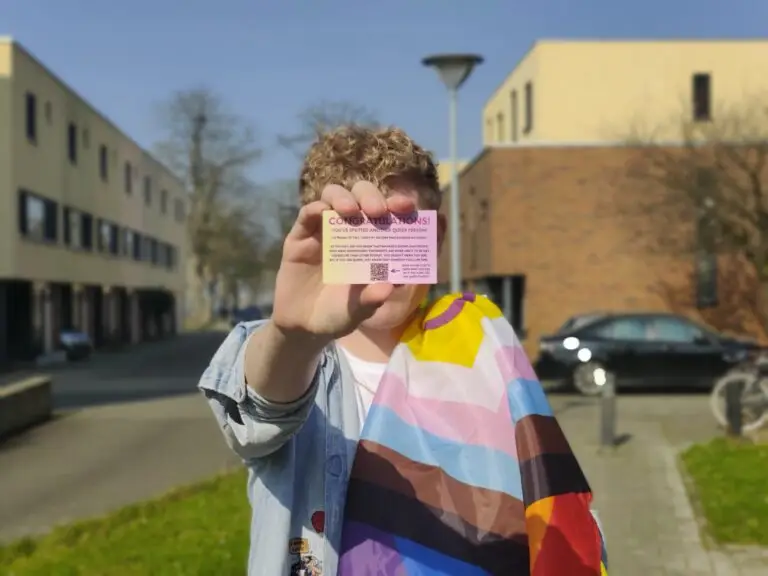
After such moments, I always wish I had a direct response—a clear choice on how to react. But these situations are so confusing that that never works. “If only I had a card or flyer ready to hand out,” I thought while we walked on, “that could solve this.” What began as a joke quickly became a serious idea. So when we arrived back home, I got to work and created a small business card (see picture below). This card is like a trophy for those who feel the need to verbally abuse us, summarizing a thought that gives me a lot of confidence. It starts with: “Congratulations! You have spotted another queer person.” Somehow, this gives me peace. It belittles these scary moments into something I know—and frankly, am bored by. Come on, is this really the extent of your creativity? It puts the weakness back on the perpetrator.

But most importantly, this card contains all the witty answers I always wish I’d had ready. Those moments immobilize and overwhelm you, making wit impossible. But with this card, the dozens of questions that race through my mind are reduced to just one: “Is it safe enough to hand out this card?” It simplifies the moment and gives me something tangible to hold onto. Sure, around the next corner it might happen again, but now I know I have a direct, witty answer ready.
A Response I May Never Give—But One I Always Share
Since carrying this card with me every day, I’ve never actually handed it out. No perpetrator with a gender or sexual identity much more fragile than mine has ever received it as a response—and that’s probably how it will stay. Most of the time, these people are too far away to even respond to (making me question who is actually afraid of whom). And of course, these situations can genuinely be dangerous—agitating someone with this card could seriously backfire. I’ll probably never use it this way. But that’s not the point. This isn’t about them; it’s about my self-confidence. Just having a witty, unexpected response ready at all times makes me worry less and allows me to care less.
Yet, I’ve used the card countless times—just not in situations of verbal harassment. Instead, I’ve found another use for it: spreading awareness. It baffles me how surprised (mainly heterosexual) people are when I discuss experiences of verbal harassment. “Really? But I thought the Netherlands was so safe and queer-friendly?” they say. The fact that we can’t walk down the street hand-in-hand or looking queer without constantly being alert and glancing over our shoulders is completely new to them. And this ignorance is dangerous, because it perpetuates their blindness to our reality. Queer liberation always stems from within our community, but we also need broader, open-minded public awareness. After all, people can only help solve issues they are aware of.
Therefore, this card isn’t just an answer to harassment; it’s primarily a response to the surprise of others. It illustrates more clearly than anything else the reality of being queer in the Netherlands—a reality so common that it warrants a standard, prepared reply. No perpetrator on the street will ever be swayed by this card (and if they do, there is a QR code for a self-help page for queer people). Even worse, using it might escalate a dangerous situation. But those close to me—acquaintances, colleagues—might be moved by it.
So I carry this card not to silence hate, but to amplify understanding—because sometimes, the strongest response is helping others see what you face every day. After all, real change begins when experiences hidden in silence become conversations shared out loud.
(1) De kwetsbaarheid van lhbt’ers | Nieuws | Rijksuniversiteit Groningen
(2) The Birth of Homonationalism
Read further with our most recent posts: